Dec, 2025, Toronto, @OCAD University

“Leaving home to go home.”
About the project
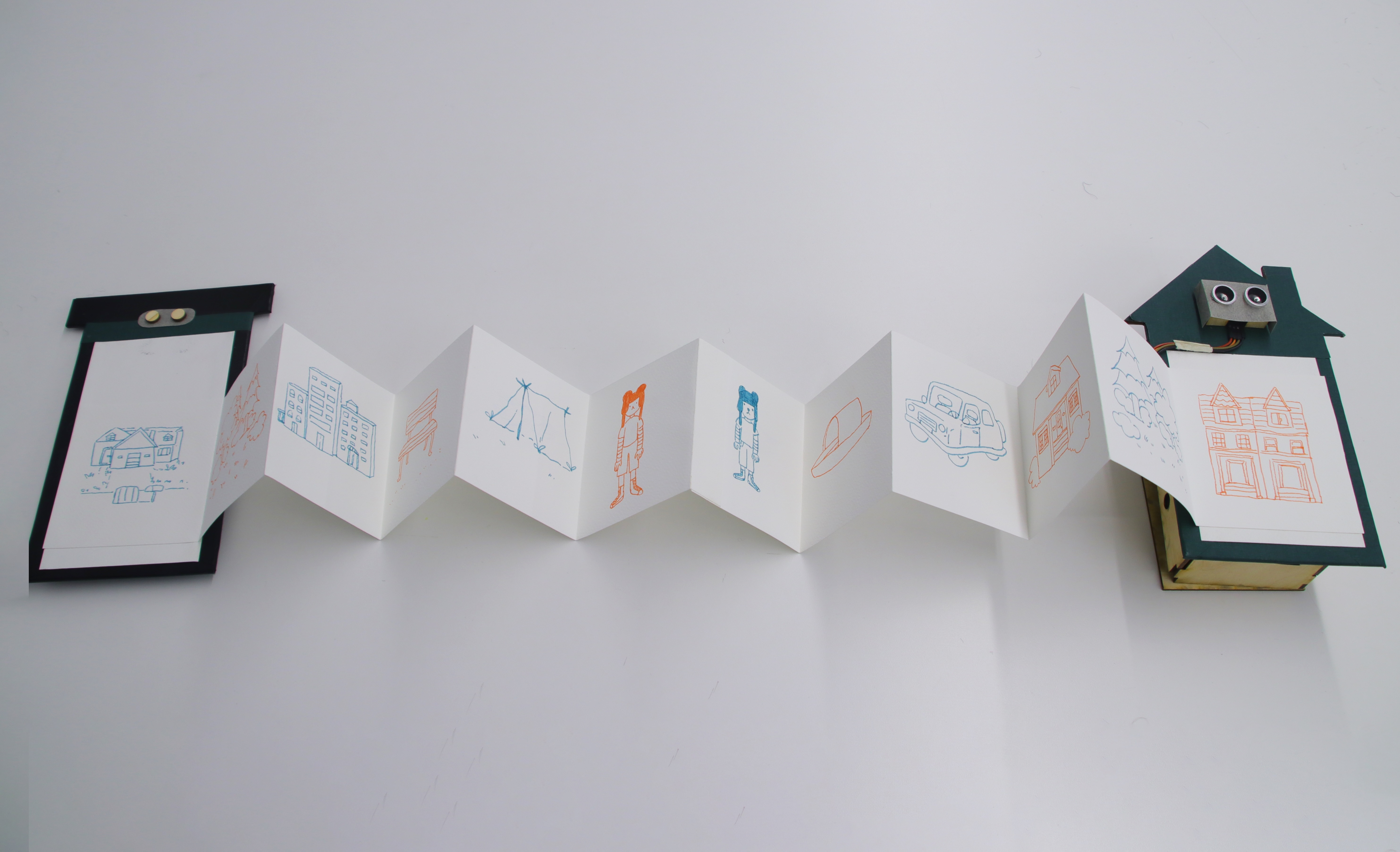
“Home Away Home” talks about the duality of the immigrant life through an accordion zine embedded with a distance sensor.

Photo by Yuhan Xia
I wanted to explore the spatial and distance relationship of home and individual in the context of immigration narrative. The two covers were made of two pieces of plywood, cut into the shape of a house and an apartment building, the shape representing the typical spatial defination of home in North America and China.


A distance sensor is embedded on the inside of one cover, which detected the distance between the two homes, and based on the reading, sent commands through BLE to the pong game as a controller.
The covers were connected through pages bound in accordion style. On one side of the pages I drew the action breakdown of a bird flying and a rabbit jumping. The motion represents the migration between homes for immigrants like me.

When flipping the pages fast and on an angle, the illustration will trun into a flip book.
On the orher side, I explored the different physical forms of home through illustraions. By having the same character on the center pages, I shared the idea of home is something we carry within as immigrants.
Pages stand for stories, memories, and narrative. They connected covers representing homes and spaces from different geographic locations. The motion of closing and opening the zine imitated the spatial and distance relationship of home to immgrants.


The zine was bound with book cloth, heavy weight cold press water colour paper, and glued with water-based adhesive. I am happy to finally try book-binding through this expirement.
Plywood were laser-cutted and assembled into a little box to hold all the electronics. The distance sensor is attached to the inner cover using jumper wires that connect to the board. The box also served as a porch to the house.

The main body of the covers are laser-cutted playwood. I also cut and rastered coordinates pointing the location of homes on both of the covers.

Two tiny pieces of wood was glued to the inner cover to support the sensor, which was hidden behind a paper cut-out.

The sensor sensed the distance from the other cover. When holding the zine, one hand holds onto the porch box, the other hand goes through a hook and loop fastener attached to the outer cover.