April, 2026, Toronto, @OCAD University

Overview
Exploring methods for bridging zine-making with tools and skills learned from the Body-Centric Tech course has been my learning goal this semester.
“What if I can make a zine interactive?”
Led by the above research question, I explored making a conductive zine with LED stickers and conductive tape circuit on paper (Chibitronics) in the Research Snack assignment. In this project, I used Capacitive sensing to make a “magic book”.
Materials:
- Felt
- Paper
- Conductive threads
- Conductive tapes
- Copper tapes
- Iron-on fabric tapes
- CPX
- Battery

The Learning
I learned about capacitive sensing from Social Body Lab’s (Social Body Lab, 2021) series of videos on how to incorporate it with various conductive materials. Touch-sensing with CPX was very fun and magical. Coming from a background of illustration and digital design, physical computation tools and materials are magical for me, each time I connect a circuit or light up a LED. Thus, I decided to translate the ecstatic feeling into this zine.


I feel like a muggle practitioner in studying physical computation. The zine was designed as a portable handbook for practicing various “spells” with the power magic (science).
The Design
Each spread of the book was sewed to the felt base with conductive threads. The threads connected the spreads and the matching touch sensing pins (A1-A7) on CPX. I learned about CPX’s touch sensor on Adafruit’s Makecode Documentation archive(Adafruit).


Makercode visualized the coding process, which I found intuitive and relatively easy to understand when working with capacitive sensing.
I found a detailed tutorial on using CPX with capacitive sensing from University of Washington’s Makeability Lab (Mekeability Lab). I experimented and edited a sample code on using CPX as a piano from Makeability Lab for my project using Makecode.

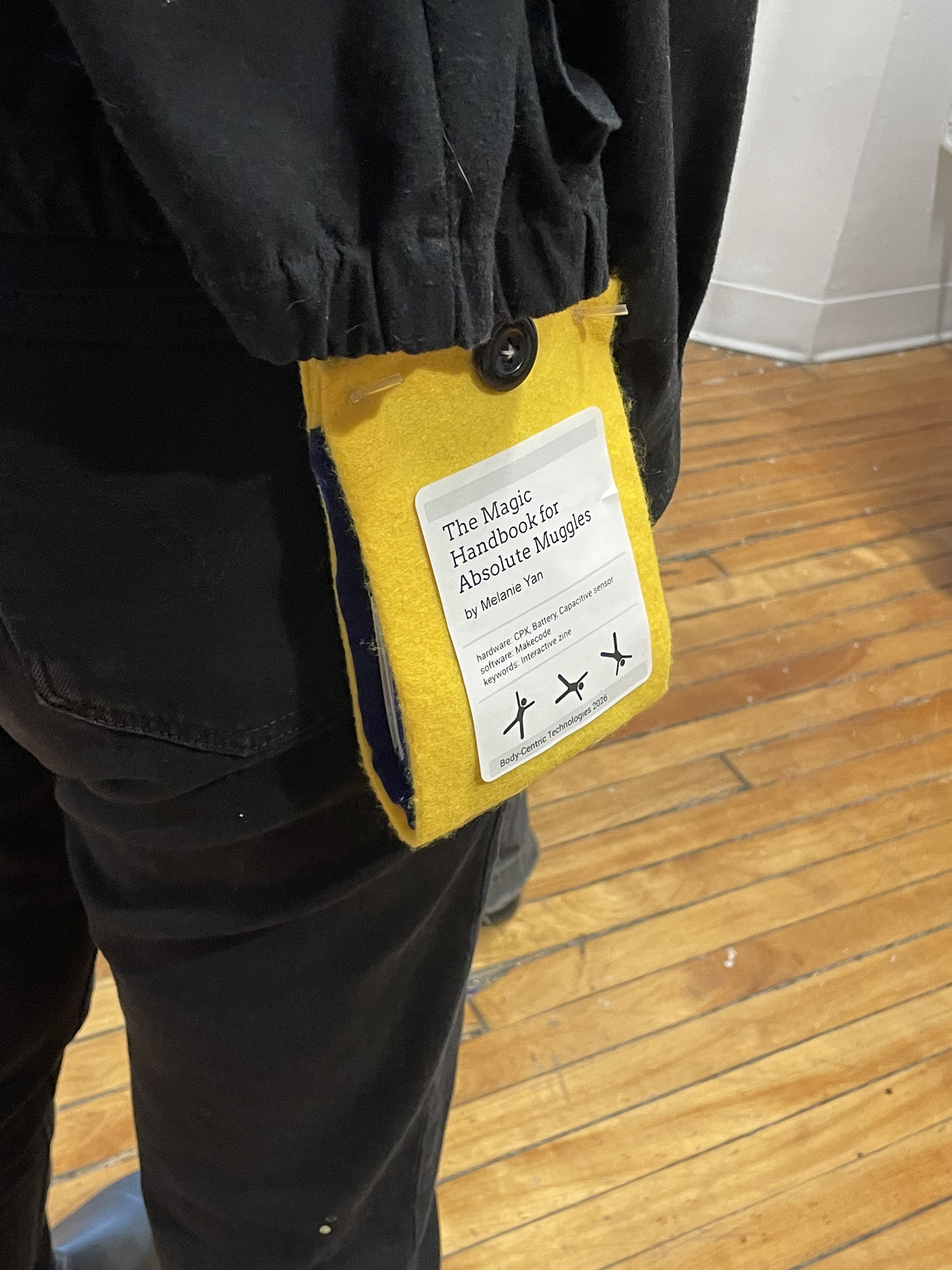
The handbook was made with felt covers which can be wore on body. Making wearable zines is also a passionate direction I would love to further explore. The placement of zines on body can be interpreted in many ways, and it can be a non-verbal expression.


Citation
Adafruit documentation touch sensor object: https://makecode.adafruit.com/learnsystem/pins-tutorial/touch-input/sensor-objects
Makeability Lab, Lesson 5: Capacitive Touch: https://makeabilitylab.github.io/physcomp/cpx/capacitive-touch.html
Social Body Lab, How to Make a Capacitive Sensor with E-Textile Materials: https://youtu.be/kTfoMyjtgws?si=0P3KRVlCUMMOTrmT
Sea Lemon, How to Stitch a Text Block for Case Book Binding :https://youtu.be/9O4kFTOEh6k?si=w5pum0gPjDFguR5P
Special Thanks
to Kate, for this amazing course;
to Thea, for sponsoring her inflatable tubes and hole puncher;
to my cat Cereal, for behaving nicely with the sewing kit and threads.