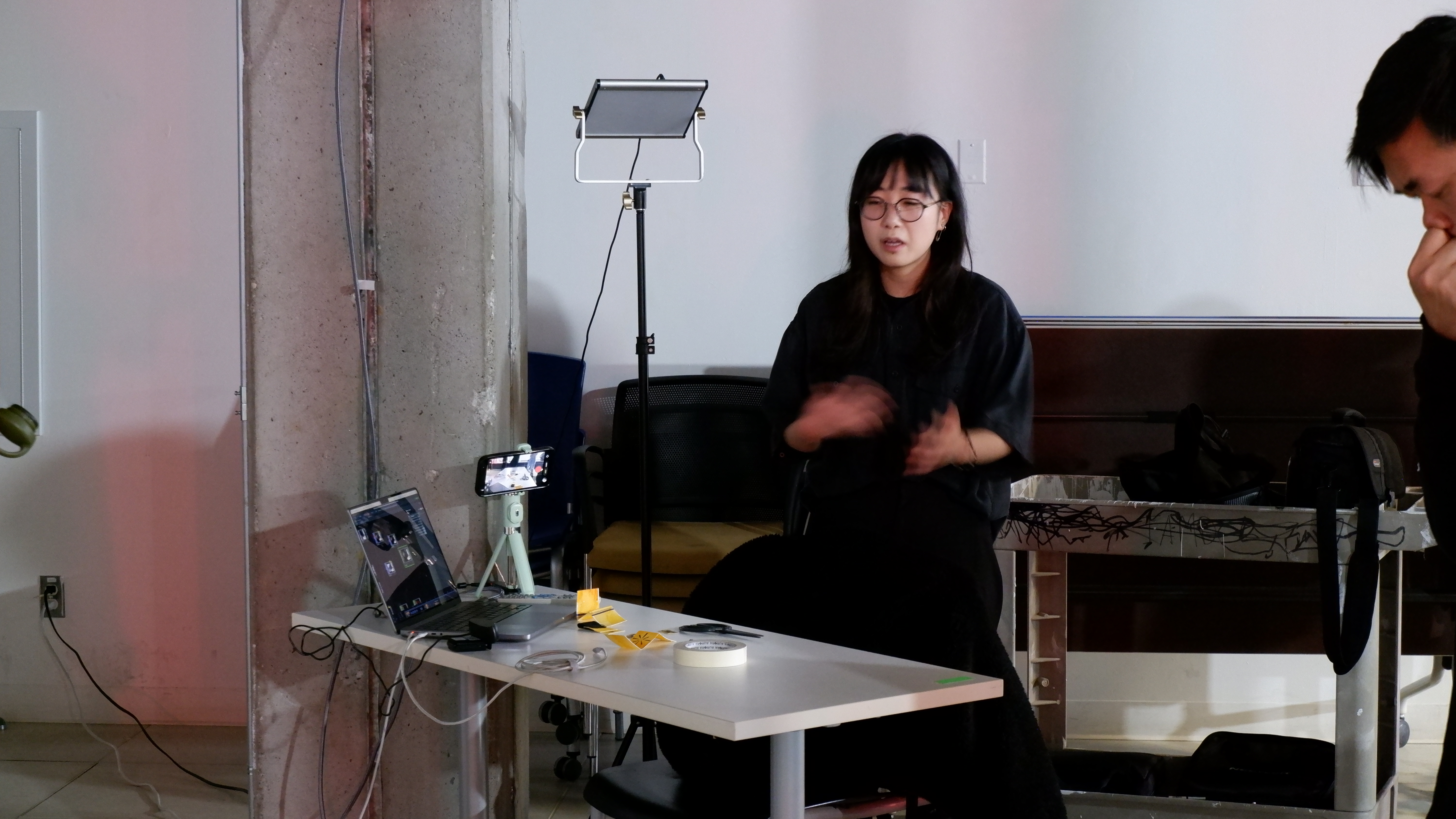
April, 2026, Toronto, OCAD University
The Editor’s Room is a performance work implementing physical computation tools, zine making techniques, and motion media projection to discuss the topic of co-living and carry-on in life with trauma.
As an autoethnographic work, The Editor’s Room extracted and recreated my personal memories and montage of life in the format of video footage and zine. I became the editor of these memories in the performance through cutting, pasting, and reassembling the zine pages. The performance can be divided into four parts: the entrance and set up, cutting and dissembling trauma, pasting and reconstructing memories, presenting reconstructed memories and exit.

Entrance, Exit, and Existence
I took inspiration from speculative design in making a fictional “room” for editing memories. The performance started and ended with entering and exiting the fictional space. The fictional space of the Editor’s Room was set up before the performance and left as it is when I exited the scene. Such design aimed to symbolize the existence of the “room” is beyond the performance period. The “room” has been there before the performance, and it will continue to exist after. The action of visiting the editor’s room changed the state of the room from standby to in-used. My role as the performer also became the role of the editor as I entered the room. The room was designed to represent my headspace at first, but after the performance I saw a potential discussion and iteration on the room’s usage. If the room’s existence is in continuity, could it be a place open for the public to edit their memories? Could anyone adapt the role of the editor? What is the relationship between the editor and the room?
Time, Zines, and the Reconstruction of Memories
Both me and this work benefited a lot from dry runs. During the initial dry run, my peers from the Asiatic Itineraries Research Centre provided a lot of valuable feedback. One of them was having two screens side-by-side to play video footage and a view of my hand movements simultaneously during the performance. The side-by-side placement of the two screens echoed the concept of “editing” from different tenses. The videos were taken in the past; representing memories I hope to edit. The webcam feed of my hand movement was the action of editing happening in the present of the performance. The interaction of time contributed to the room’s characteristic of being a fictional place where time is not chronological but simultaneously


happening. The two screens can also be interpreted as the two angles of the action of editing memory since the video footages stood for the content of memories, and the live feed showed the motion of editing. Similar to the video footage, the zines hung on my glasses also stood for memory pieces. Two zines were created and used in the piece. One is a smaller accordion zine painted in golden yellow and drawn with illustrations that were moments from my childhood memories and memories with my past grandfather. This zine was attached to my glasses like a glasses chain in the performance. I wore them as I entered the editor’s room. By having the zine attached to my glasses, I wanted to express how I carried the memories around and how they shaped my perspective. Binding zines with objects and different materials is something I am interested in exploring and experimenting with. During the performance, I cut off the pages from the glasses zine symbolizing the process of editing memories. The cut-offs were reattached to a different zine. The second zine in this performance is a very long accordion zine painted with organic shapes formed by lines and has threads sewed on the pages. The long zine carried the cut-off pieces to complete the process of reconstructing memories. As the carrier of the result of editing, the long zine symbolized life narrative and continuity. The patterns could be water, tree rings, or shells. All are natural elements representing life, growth, and metrics of time. The action of pasting the glasses zine onto the long zine represented digesting traumatic memories from the past and carry on.


A New Understanding of Performance
This advice of having two screens projected immediately solved my question on “how to express emotions naturally during a performance”. Before this work, I had a very limited understanding of performance as an art form. The performance experience taught me a lot about feeling the moments. Moments and time are recurring themes in my works. Previously, I used illustrations, analog visual storytelling, and 2-dimensional media to explore moments and time. Performance opened a new world since it is a time and space related art form. I experienced moments and developed new memories while discussing the topic of time and memory during a performance. Implementing interdisciplinary methods and techniques into performance also future creation possibilities.


